vrijdag 19 december 2008

How does it work?

Here a movieclip about a peoplecounting. In here you will see what it counts and escpecially how it counts.

Woolworths verleden tijd vanaf januari


LONDEN – Curator Deloitte stelt dat vanaf 5 januari in het nieuwe jaar alle 807 vestigingen van Woolworths in de UK de deuren hebben gesloten.


De massale sluiting van alle winkels begint op 27 december van dit jaar. Alle 27.000 vaste werknemers en uitzendkrachten verliezen hun baan als er voor die tijd geen koper wordt gevonden voor de noodlijdende warenhuisketen.


Geen deal

De curatoren bevestigen dat er interesse is voor verschillende locaties waar nu een Woolworths staat, maar dat ze ver verwijderd zijn van een mogelijke deal voor de verkoop van het bedrijf. Voor 300 locaties is er een bod uitgebracht door verschillende retailers. Getracht wordt om de huidige werknemers van deze winkels onder te brengen bij de potentiële nieuwe werkgevers.


Hema opent 'worstloze' winkel in Parijs


PARIJS - De Hema opent half januari in Frankrijk haar eerste vestiging. Het filiaal komt in Parijs, in winkelcentrum Créteil-Soleil in het zuiden van de stad.


‘Het is een grote stap voor ons. De Fransen kennen de Hema nog niet,’ zegt woordvoerder Judy op het Veld in het Algemeen Dagblad. Bij het Franse filiaal worden de bekende typische Nederlandse producten zoals rookworst en gebak niet verkocht. Snoep en verpakte etenswaren maken wel deel uit van het assortiment. Toevoeging


De naam Hema krijgt in Parijs een toevoeging, namelijk ‘Depuis 1926’ (sinds 1926). De warenhuisketen begint in Frankrijk met afgeronde eenheidsprijzen zoals 1,50 euro en 4 euro. Daar heeft de Hollandsche Eenheidsprijzen Maatschappij haar naam in Nederland aan ontleend. ‘Wij denken dat dat heel duidelijk is voor de nieuwe Franse klanten’, zegt Op het Veld.


UitrolDe Hema wil zich ook in Frankrijk profileren als hét warenhuis voor de dagelijkse boodschappen. Op het Veld kan nog niets zeggen over een verdere uitrol in Frankrijk. ‘We gaan eerst dit filiaal goed doen, daarna kijken we verder.’

vrijdag 12 december 2008

iPod Touch or people counter device? by Brent Gustafson

Here’s an interesting problem that came across my desk several weeks ago. Lets say you want to know exactly how many people are in a gallery at any given time. How do you do it?


There are expensive people counters available, with all sorts of technology, right down to thermal imaging. There are also cheap hand held counters, with plus and minus buttons to add and subtract people as they come and go to keep a consistent count of people in a gallery.
These cheap hand held versions are great…if you only have one entrance and exit point. What if you have multiple entrances and exits? Suddenly the hand held version falls apart, and putting cameras all over is way too expensive.


This is the issue that was put forth to me. We have an upcoming exhibition for Frida Kahlo. The gallery that the exhibition is in can only support 200 visitors at any one time. We expect more than that, especially on busy days. The kicker of course is that the gallery it’s in has two entrances, so we needed to find a way to accurately count how many people are in the gallery at any given time, and if that number goes over 200, the gallery guards would have to hold people from entering until the number dropped below 200.


I thought for sure something like this must have been made before. Surely we aren’t the only people who have ever had this problem? But in looking online I couldn’t find anything that was cost effective and would “just work”. We kept saying “if we only had two clickers that could talk to each other”.


Something interesting happened the same day I was presented with this problem. Apple announced the iPod Touch. As soon as I saw the Touch, my first thought was Art on Call and the Walker Channel. I could see all sorts of uses for both in the galleries. But after a couple hours wrestling with this given problem it hit me, why not use the iPod Touch?


The iPod Touch is handheld, has touch input, and a browser with wifi built in. All we had to do was make a simple web app for it that counted up or down. Two people could have the Touch’s, check off how many people are entering and leaving, and both be up to date on exactly how many people are in the gallery. So that’s what we did.


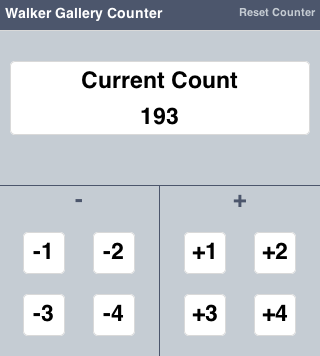
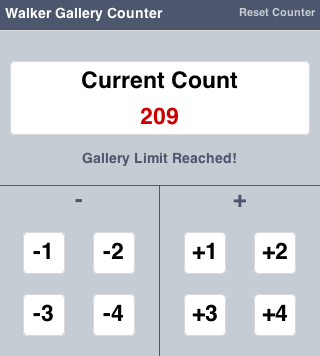
Here are some screen grabs of what I built. The left image is the typical display of the app. Options are simply to add or subtract a certain amount of people as they enter or leave. You’re able to reset the counter to zero in the upper right (it has a confirmation before doing so). The right image shows what happens when you go over the gallery maximum. The app also auto updates the number every 10 seconds, so the guard who has people waiting will know when the the number drops below the max value right away without needing to manually refresh.


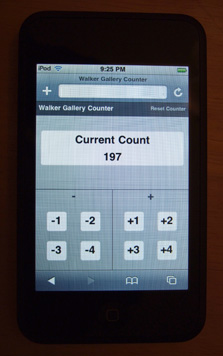
Making a web app specifically for the iPod Touch (or iPhone) turns out to be really easy. It’s just a webpage. You pretty much can do anything that is available in Safari (though there are a few inconstancies to watch out for), and there are also several special meta tags you can add specifically for these apps (for example, I turned off scaling for our web app). Apple has written up a very nice development doc on their website that I used when making this app. It includes things like screen size, font size, color, meta tags, basically everything you need to make something look nice and stylish on these devices. I’d recommend it to anyone working on apps like this. The screenshot to the left is how the iPod Touch looks with the rest of the UI around it, to give you an idea.

As far as the iPod Touch/iPhone goes, I’m very impressed. I really do think these devices are the future of museum audio tours. Well, not just audio, but video as well! There are things that need to be fixed (like the fact that you can’t get podcasts on them via wifi yet), but overall there is so much potential here, simply by having a real browser with wifi on it and supporting rich media, as well as the UI and multi-touch interface. It could very well be the Rosetta Stone of digital museum tours.

Source: http://blogs.walkerart.org/newmedia/2007/10/05/counting-people-galleries-ipod/

woensdag 10 december 2008

Vastned verkoopt 50 winkelpanden (door Joep Meijsen)


ROTTERDAM – Beleggingsfonds VastNed Retail heeft een portefeuille met vijftig winkelpanden verkocht. De koper is een particuliere belegger die 37,1 miljoen euro neertelt voor het pakket.

Dat heeft VastNed Retail bekendgemaakt. Het betreft een pakket met winkels in grote en kleine steden in Nederland die samen goed zijn voor een huuropbrengst van 2,8 miljoen euro.

De verkoop wordt nog deze maand afgerond en de opbrengst wordt door VastNed Retail gebruikt om bankleningen af te lossen.De verkoopprijs is gelijk aan de boekwaarde. De verkoop betreft onder meer een pand aan de Beijerlandselaan in Rotterdam, de Bergerweg in Sittard en de Stationsstraat in Ermelo.

donderdag 4 december 2008

Winkelhuren pieken ondanks recessie


DOETINCHEM – De winkelhuren blijven ondanks de economische neergang ongekend hoog. Op Fifth Avenue in New York moet maar liefst 12.612 euro per vierkante meter worden neergeteld. In 94 procent van de 236 onderzochte straten is de winkelhuur op z’n minst stabiel.


Dat blijkt uit het onderzoek Main Streets Across The World, zo meldt Retail News. Dit is het jaarlijkse onderzoek van de internationale vastgoedadviseur Cushman & Wakefield naar de tophuurprijzen van winkels in 48 landen. Fifth Avenue is hiermee opnieuw de duurste straat ter wereld. De prijzen stegen hier zelfs met 23 procent ten opzichte van 2007.Hong Kong, Parijs, Milaan en Dublin completeren de top vijf van duurste winkelstraten.


Dublin stijgt met twee plaatsen het meest in de toptien van de ranglijst. De huren stijgen ook op de Nederlandse markt, zegt Baldwin Poolman, managing partner van Cushman & Wakefield. ‘Deze sterke huurgroei is aan het afkoelen door het veranderende marktsentiment, hoewel in het afgelopen jaar nog wel sprake was van huurgroei.
Status aparte
De vraag naar toplocaties in de grotere steden blijft op peil, voornamelijk door internationale moderetailers.


Ook op de Kalverstaat is sprake van een minder sterke huurgroei dan in voorgaande jaren. De tophuur voor een vierkante meter winkelvloer bedraagt hier 2.400 euro per jaar. De Kalverstraat blijft met deze huurprijs echter een status aparte houden in het Nederlandse winkellandschap.’


Winkelstraten steeds meer eenheidsworst


NIJMEGEN – Het aantal verschillende soorten winkels in Nederland neemt af en winkelcentra in Nederland worden steeds eenvormiger.


Dat blijkt uit cijfers van het CBS. Tussen 2004 en 2008 zijn in buurten met de grootste verscheidenheid aan winkels 73 soorten winkels opgeheven. Daar zijn slechts 60 nieuwe soorten winkels voor in de plaats gekomen.


Vertrokken zijn vooral winkels in huishoudelijke artikelen, handwerkwinkels, winkels in witgoed, winkels gespecialiseerd in overige bouwmaterialen en caravandealers. OpmarsIn de periode 2004-2008 zijn er in de top 15 winkelbuurten vooral winkels met een algemeen assortiment, kantoor en schoolbenodigdheden, en boekwinkels bij. Ook zijn er steeds meer reparatiebedrijven voor uurwerken en elektrische huishoudelijke artikelen geopend.


Verscheidenheid NijmegenHet centrum van Nijmegen heeft de grootste verscheidenheid aan winkels in Nederland. Volgens het CBS telt het centrum van Nijmegen 66 verschillende soorten winkels in uiteenlopende branches. Hiermee is het centrum van Haarlem, dat sinds 1996 op de eerste plaats stond, voorbij gestreefd.